The Cosmos interoperability advantage
Most blockchains operate as isolated silos, forcing users to rely on centralized exchanges or trust-based bridges to move assets between networks. These bridges are frequent targets for exploits, creating significant counterparty risk for DeFi participants. Cosmos solves this fragmentation with the Inter-Blockchain Communication (IBC) protocol, a standardized communication layer that allows independent blockchains to exchange data and tokens securely.
IBC functions as a verified protocol rather than a traditional bridge. It uses light clients to verify the state of remote chains, ensuring that assets move without relying on a centralized intermediary. This architecture reduces the attack surface for cross-chain transfers, making it a preferred infrastructure choice for institutions seeking secure interoperability. As noted by Cosmos, this approach enables a "secure and performant blockchain for institutions" by prioritizing verified trust models over speculative reliability.
For DeFi, this means liquidity is no longer trapped in a single chain. Protocols can tap into deeper liquidity pools across the Cosmos ecosystem without sacrificing security. This modularity allows developers to build specialized chains for specific use cases—such as high-speed trading or privacy—while still connecting to the broader network. The result is a flexible infrastructure where value can flow freely, much like data moving across the early internet.
This structural advantage positions Cosmos as a foundational layer for next-generation DeFi. By decoupling execution from consensus, it allows for greater innovation and resilience. The network’s ability to connect diverse blockchains creates a cohesive ecosystem where assets and data can interact seamlessly, offering a robust alternative to monolithic chain architectures.
Leading DeFi Protocols on Cosmos
The Cosmos ecosystem functions less like a single blockchain and more like a network of specialized financial zones. Each zone connects via IBC, allowing assets and data to move without centralized intermediaries. Within this modular infrastructure, specific DeFi protocols have emerged to handle distinct tasks: liquidity aggregation, cross-chain swaps, and modular lending. Understanding these applications reveals how the network delivers tangible utility beyond speculative trading.
Osmosis: The Central Liquidity Hub
Osmosis operates as the primary decentralized exchange (DEX) within the Cosmos ecosystem. It uses a concentrated liquidity model that allows traders to provide capital to specific price ranges, increasing capital efficiency compared to traditional automated market makers. For users, this means tighter spreads and better execution for large trades. For the broader network, Osmosis acts as a liquidity aggregator, pulling depth from multiple zones to ensure that tokens moving via IBC can be swapped with minimal slippage.
The protocol’s native token, OSMO, is designed to incentivize liquidity provision and governance. Stakers lock their tokens to vote on fee tiers and new pool listings, aligning their interests with the health of the exchange. This mechanism ensures that the most liquid pools remain competitive, creating a self-reinforcing cycle where deeper liquidity attracts more traders, which in turn attracts more liquidity providers.
Kava: Bridging Cosmos and Ethereum
While Osmosis handles trading, Kava focuses on lending and borrowing, specifically targeting the bridge between Cosmos and Ethereum. Kava leverages IBC to bring Cosmos-based assets into its lending markets, while also integrating with Ethereum through the Cosmos Hub’s IBC-ETH bridge. This dual approach allows users to borrow against assets that would otherwise be siloed in their native chains.
Kava’s architecture is modular, separating its consensus layer from its application layer. This design allows the network to upgrade its financial products without disrupting the underlying blockchain security. The native KAVA token is used for governance and as collateral within the lending markets, providing a stable utility base that is tied directly to the volume of loans issued on the platform.
Comparison of Top Cosmos DeFi Protocols
The table below compares the leading DeFi applications by their primary function and market role. This data reflects the current structural utility of the ecosystem, focusing on how each protocol contributes to the network’s overall financial infrastructure.
| Protocol | Primary Function | Native Token Utility |
|---|---|---|
| Osmosis | Decentralized Exchange & Liquidity Aggregation | Governance & Liquidity Incentives |
| Kava | Lending & Borrowing (Cross-Chain) | Governance & Collateral |
| Stride | Liquid Staking | Governance & Fee Discounts |
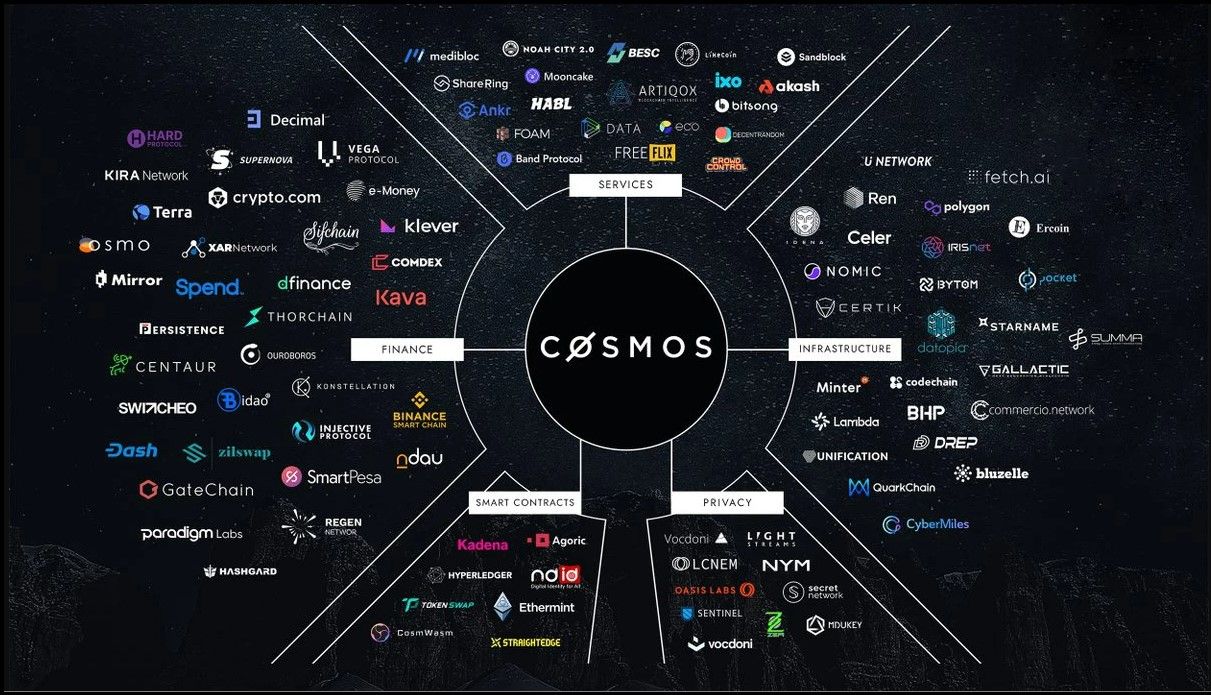
These protocols demonstrate the modular nature of Cosmos. Rather than forcing every application to run on a single, congested chain, developers can build specialized financial tools that communicate seamlessly. This specialization reduces complexity and improves performance, allowing each zone to optimize for its specific use case while still benefiting from the security and connectivity of the wider network.
ATOM Tokenomics and Staking Dynamics
The economic model of the Cosmos Hub (ATOM) has undergone significant restructuring to align validator incentives with network health. Historically, ATOM suffered from high inflation and low value accrual, as staking rewards were distributed broadly across the ecosystem without a clear mechanism for the Hub itself to capture fees. The introduction of Interchain Security (ICS) changed this dynamic by allowing Cosmos Hub validators to secure multiple zone chains, creating a more robust security layer while introducing new revenue streams.
Staking Yields and Inflation
ATOM operates on a proof-of-stake model with a target inflation rate that adjusts based on the percentage of tokens actively staked. Currently, the annual inflation rate hovers around 7-8%, though this is not fixed and decreases as more ATOM is staked. Validators charge a commission on the rewards they earn for their delegators, which typically ranges from 5% to 20%. This means the net yield for a delegator is the base inflation reward minus the validator’s commission.
Unlike Ethereum, where staking rewards are largely derived from transaction fees and MEV (Maximal Extractable Value), Cosmos Hub rewards are primarily inflationary. However, the Cosmos Hub is exploring a fee-burn mechanism similar to Ethereum’s EIP-1559, which could eventually reduce inflationary pressure by burning a portion of transaction fees. Until this implementation is fully active, staking remains largely an inflation-driven yield opportunity.
Interchain Security and Value Accrual
Interchain Security allows the Cosmos Hub to lease its security to other chains in the ecosystem. When a new zone chain joins, it pays a fee in ATOM to the Cosmos Hub validators. These fees are distributed among the validators and, crucially, can be used to buy back and burn ATOM from the open market. This creates a direct feedback loop: as more chains rely on Hub security, demand for ATOM increases, potentially offsetting inflationary sell pressure.
This model shifts ATOM from a purely speculative asset to a functional utility token with intrinsic demand drivers. The value accrual is no longer just about network activity on the Hub itself, but about the broader security of the Cosmos ecosystem. Validators who participate in ICS often see higher total rewards due to these additional fee streams, making them more attractive to delegators seeking stable yields.
Technical outlook for ATOM price
ATOM price action currently reflects the tension between Cosmos’s modular infrastructure utility and broader market sentiment. The token has spent significant time in what traders call an accumulation zone, characterized by lower volatility and consolidation near key historical support levels. This pattern suggests that the market is digesting recent developments in the IBC protocol and the upcoming ATOM 2.0 tokenomics reforms, which aim to reintroduce inflation and staking rewards to incentivize long-term holding.
The daily and weekly charts reveal a clear range-bound structure. Resistance sits firmly around the $7–$8 level, a zone that has rejected multiple rallies over the past year. Conversely, support has held steady near the $5–$6 floor, providing a base for potential accumulation. A decisive break above the upper resistance with sustained volume would signal a shift in momentum, potentially targeting higher liquidity zones. Until then, the price remains tethered to Bitcoin’s broader movements, though Cosmos often shows higher beta during altcoin season.
The path to significant upside, such as the $10 mark discussed in various market analyses, is unlikely to be linear. It will likely require a combination of increased IBC adoption, successful execution of the 2.0 reforms, and a favorable macroeconomic environment for risk assets. Investors should watch for volume spikes on upward moves as confirmation of trend reversal rather than relying on price alone.
Evaluating Cosmos ecosystem risks
Cosmos Hub is the only interoperability layer that doesn't ask you to pick a side — a genuine breakdown vs ETH, SOL, DOT, AVAX.
While the IBC protocol offers a unique advantage in cross-chain connectivity, it introduces significant complexity. Unlike Ethereum's monolithic approach or Solana's single-chain high-throughput model, Cosmos relies on a modular framework where security is not inherent but negotiated. This means that while individual chains can customize their consensus mechanisms, the overall ecosystem's resilience depends on the security posture of each connected zone. If one chain in the network is compromised, the trust assumptions for IBC-based assets can be strained, creating a fragmented security landscape that is harder to audit than a unified L1.
Regulatory uncertainty also looms large. As decentralized finance (DeFi) applications built on Cosmos chains grow, they face increasing scrutiny regarding token classification and cross-border data flows. The modular nature of the ecosystem, which allows for rapid innovation, can also lead to inconsistent compliance standards across different zones. Investors and developers must navigate a patchwork of regulations that vary by jurisdiction, adding a layer of operational risk that is less prevalent in more centralized or single-jurisdiction-focused ecosystems.
Competition from other Layer 1s remains fierce. Ethereum's ongoing upgrades, such as sharding and rollup-centric scaling, aim to reduce the need for complex interoperability bridges by providing a unified settlement layer. Similarly, Solana and Avalanche continue to attract high-throughput applications with their own native solutions. Cosmos must continue to demonstrate that its modular approach offers tangible benefits in terms of customization and sovereignty, rather than just complexity, to maintain its relevance in a crowded market.
Common questions about Cosmos DeFi
Investors often search for specific price targets, but Cosmos (ATOM) operates differently than simple store-of-value assets. Its value is tied to network utility, staking yields, and the success of its IBC protocol rather than isolated speculation.
Can Cosmos reach $10?
Reaching $10 is technically possible but requires sustained ecosystem growth. Analysts suggest this would likely occur during a broader market cycle expansion, potentially spanning 2026 or 2027, as it demands significant increases in Total Value Locked (TVL) and active IBC transactions. It is not a short-term target but a long-term infrastructure milestone.
Can Cosmos atoms hit $500?
A $500 price point for ATOM is currently unrealistic given the token's circulating supply and market capitalization. Such a valuation would exceed the total market cap of many established global corporations. While the Cosmos ecosystem is expanding, this specific price target ignores basic economic constraints and is not supported by current network metrics or developer activity reports.
What is the main utility of ATOM?
ATOM is primarily used for securing the Cosmos Hub through staking and participating in on-chain governance. Holders stake ATOM to validate transactions and earn rewards, while also voting on protocol upgrades. It also serves as the base currency for IBC transfers, allowing it to bridge value between different blockchain zones within the Cosmos ecosystem.
No comments yet. Be the first to share your thoughts!