ATOM Market Context and Price Action
Cosmos (ATOM) is currently trading around $1.55, with a 24-hour trading volume hovering near $31.7 million. This price point reflects the asset's position as a foundational interchain layer rather than a standalone consumer application. The market cap suggests that ATOM remains a significant player in the interoperability space, though its price action has often lagged behind the broader narrative of dedicated L1 blockchains.
The current valuation is influenced by the unique tokenomics of the Cosmos Hub. Unlike many L1s that rely solely on transaction fees, ATOM holders participate in network security through staking. This utility provides a floor for demand, but it also means that price appreciation is closely tied to the health and adoption of the broader IBC (Inter-Blockchain Communication) ecosystem. Recent technical analysis indicates that ATOM is testing key support levels, with resistance forming at higher psychological marks.
To understand the immediate trajectory, it is helpful to look at the live market data. The following widget provides the real-time price and volume, offering a clear snapshot of current market sentiment.
For a deeper look at the technical structure, the chart below highlights recent price action and critical support/resistance zones. This visual context is essential for identifying potential entry points or risk levels for investors evaluating the Cosmos ecosystem.
Interchain Security and Infrastructure Upgrades
Cosmos has shifted from a loose collection of independent blockchains to a coordinated network of sovereign appchains. The core of this transition is Interchain Security (ICS), a protocol that allows established chains to lease their security to newer, smaller networks. This model solves the "cold start" problem for new projects: instead of struggling to attract their own validators, a new chain can borrow the robust security of established players like Cosmos Hub.
This shared security model is similar to a franchise business model. The main brand (the consumer chain) provides the reputation and security infrastructure, while the local franchise (the appchain) focuses on its specific user experience and tokenomics. For developers, this means they can launch a chain with institutional-grade security from day one, rather than spending months or years building a validator set from scratch. The result is a more resilient ecosystem where security is a commodity, not a barrier to entry.
The technical implementation relies on a Permissioned Validator Set (PVS). When a consumer chain connects to a provider chain like Cosmos Hub, specific validators are selected to validate blocks on both networks. This creates a direct economic link: if a validator acts maliciously on the consumer chain, they risk slashing on the provider chain. This alignment of incentives ensures that the security provided is genuine and not just theoretical.
While ICS strengthens the network, it also centralizes some power. If too many consumer chains rely on a single provider, that provider becomes a critical bottleneck. The Cosmos ecosystem is actively working to mitigate this by encouraging a multi-provider model, where consumer chains can split their security across multiple providers. This diversification ensures that no single chain holds too much sway over the broader network, maintaining the decentralized ethos that defines the Cosmos architecture.
Leading Cosmos DEXs and Liquidity Hubs
Decentralized exchanges on the Cosmos network act as the primary liquidity aggregators for the interchain ecosystem. Unlike siloed blockchains, Cosmos DEXs are built to bridge assets across independent zones, allowing users to swap tokens without relying on centralized intermediaries. This architecture is critical for maintaining deep liquidity in a fragmented market.
Osmosis stands as the dominant force in this space, leveraging its concentrated liquidity model to facilitate the highest trading volume within the ecosystem. It functions less like a traditional exchange and more like a liquidity hub, where users can provide liquidity to various asset pairs and earn fees from cross-chain swaps. Its design allows it to integrate with other Cosmos chains seamlessly, making it the go-to venue for interchain asset management.
While Osmosis leads in volume, other specialized DEXs offer unique advantages for specific use cases. Some focus on privacy-preserving trades, while others prioritize speed and low fees for high-frequency trading. Understanding these distinctions helps traders choose the right venue for their specific needs, whether they are moving large volumes of ATOM or swapping smaller altcoins.
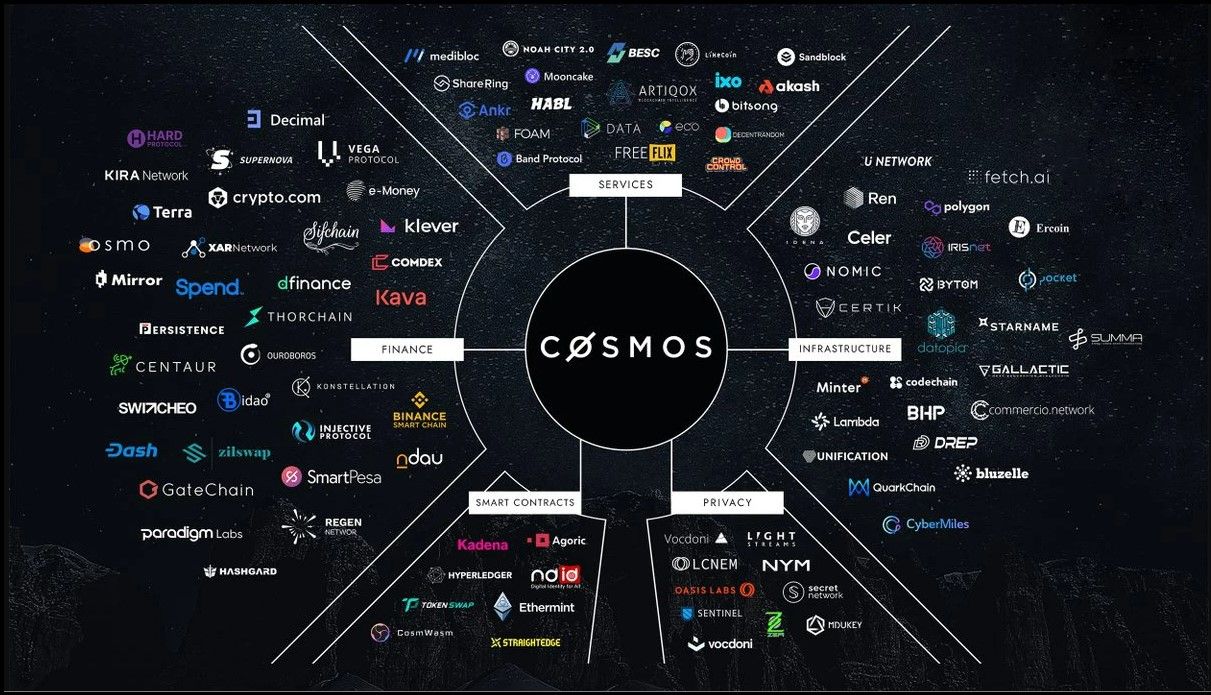
To understand the current market dynamics, it is helpful to compare the key metrics of the leading platforms. The table below outlines the primary differences in trading volume, total value locked (TVL), and unique features that define each exchange's role in the Cosmos economy.
| DEX | TVL | 24h Volume | Key Feature |
|---|---|---|---|
| Osmosis | $150M+ | $10M+ | Concentrated Liquidity |
| Kujira | $50M+ | $1M+ | Derivatives & Perps |
| Axelar DEX | $20M+ | $500K+ | Native Interchain Swaps |
Trading activity on these platforms is closely tied to the performance of the ATOM token and the broader Cosmos ecosystem. For traders looking to monitor the underlying asset's price action, live data is essential for making informed decisions.
How cross-chain bridges move assets
Moving value out of the Cosmos ecosystem requires bridging, a process that connects independent blockchains to external networks like Ethereum. While the Cosmos SDK allows for native interoperability between IBC-enabled chains, reaching the broader crypto market demands these external bridges. They act as the toll roads for liquidity, allowing ATOM and other Cosmos assets to participate in Ethereum's decentralized finance (DeFi) protocols.
The most prominent example is the Gravity Bridge, which facilitates two-way transfers between Cosmos and Ethereum. Gravity Bridge uses a unique security model that relies on an Ethereum smart contract and a set of Cosmos validators. This design aims to minimize trust assumptions compared to traditional multi-signature bridges. By anchoring the bridge's security in Ethereum's consensus layer, it provides a more robust framework for high-value asset transfers, though it introduces complexity in maintaining validator sets across both chains.
Security remains the primary concern for any cross-chain infrastructure. Bridges have historically been the most frequent target for hacks, as they consolidate value from multiple chains into a single point of failure. When evaluating a bridge, look for its consensus mechanism and whether it relies on optimistic verification or cryptographic proofs. The goal is to find bridges that distribute risk rather than centralizing it, ensuring that the movement of assets does not compromise the integrity of the underlying networks.
Cosmos vs. Polkadot: Architecture and DeFi Flexibility
Choosing between Cosmos and Polkadot often comes down to how you want your DeFi applications to interact. While both aim to solve blockchain interoperability, their underlying architectures take fundamentally different paths. Cosmos prioritizes sovereign chain independence through the Cosmos SDK, whereas Polkadot emphasizes a shared security model via its Relay Chain.
Cosmos chains are built using the Cosmos SDK, a modular framework written in Go. This approach allows developers to spin up independent blockchains that maintain their own governance, tokenomics, and security. Interchain communication happens through the Inter-Blockchain Communication (IBC) protocol, treating each chain as a distinct entity that can freely trade assets with others. This "internet of blockchains" model offers maximum flexibility but requires each chain to manage its own validator set and security posture.
Polkadot, by contrast, operates on a hub-and-spoke model. Parachains (specialized chains) connect to a central Relay Chain, which handles consensus and shared security. This means parachains don't need to bootstrap their own validator networks, reducing friction for new projects. However, this comes with more centralized governance and tighter integration constraints compared to Cosmos's sovereign chains. The choice often boils down to whether you value total autonomy (Cosmos) or shared efficiency (Polkadot).
Technical Comparison
The table below highlights the core structural differences that impact DeFi development and deployment.
| Feature | Cosmos | Polkadot |
|---|---|---|
| Architecture | Independent sovereign chains | Hub-and-spoke (Relay Chain) |
| Development Language | Go (Cosmos SDK) | Rust (Substrate) |
| Consensus | Tendermint BFT | Nominated Proof-of-Stake (NPoS) |
| Interoperability | IBC Protocol | Cross-Consensus Messaging (XCM) |
| Shared Security | No (Chain-specific) | Yes (Relay Chain) |
| Governance | On-chain (Token holders) | On-chain + Council + Technical Fellowship |
Common questions about Cosmos DeFi
Investors often look for clear answers on price potential and architectural advantages when evaluating interchain assets. Below are direct responses to the most frequent questions regarding ATOM's market trajectory and its standing against competing Layer-0 solutions.
For a deeper technical view of ATOM's price action and volume trends, refer to the live chart below. This data reflects real-time market conditions and is essential for timing entry or exit points in the current volatility.
No comments yet. Be the first to share your thoughts!