Cosmos market snapshot and ATOM price
The Cosmos ecosystem operates as a distinct financial layer within the broader crypto landscape, and ATOM serves as its primary governance and utility token. To understand the potential for interchain yield, we first need to establish the current financial baseline. ATOM is currently trading around $1.51, with a 24-hour trading volume hovering near $36.6 million [CoinMarketCap]. This price action reflects the token's position as a foundational infrastructure asset rather than a high-frequency speculative instrument.
While the market capitalization provides a sense of scale, the more critical metric for a Cosmos crypto DeFi analysis is the token's utility within the Interchain. ATOM is not just a store of value; it is the fuel that secures the Cosmos Hub and facilitates cross-chain communication. However, this utility comes with significant trade-offs. The token's price has faced downward pressure due to inflationary emission schedules and the competitive landscape of other Layer-1 blockchains. Investors must weigh the long-term value of the Interchain against these immediate macroeconomic headwinds.
The technical chart above highlights recent price action and key support levels. For those analyzing the Cosmos market snapshot, it is essential to recognize that ATOM's value proposition is tied to the adoption of the Cosmos SDK and the growth of the Interchain Security model. The current price reflects a market that is cautious but attentive to the ecosystem's development. As we move into the deeper analysis of yield opportunities, keep in mind that the infrastructure's strength does not always translate immediately to token price appreciation.
The risk level here is high. While the technology is robust, the tokenomics and market sentiment can be volatile. The current snapshot shows a market in consolidation, waiting for the next catalyst in the form of major interchain integrations or protocol upgrades. Understanding this baseline is crucial before evaluating the specific yield strategies available within the Cosmos ecosystem.
How IBC infrastructure drives DeFi liquidity
The Cosmos network solves one of the most persistent problems in decentralized finance: liquidity fragmentation. In a traditional blockchain ecosystem, capital is often trapped within a single chain, unable to interact with assets or protocols on other networks without expensive, slow, and risky bridge solutions. The Inter-Blockchain Communication (IBC) protocol changes this dynamic by providing a secure, open-source communication layer that allows distinct blockchains to exchange data and value directly.
Think of IBC as the TCP/IP of the blockchain world. Just as TCP/IP allows different types of computers to communicate over the internet, IBC allows sovereign blockchains to talk to each other. This means a user on the Osmosis decentralized exchange can seamlessly provide liquidity for assets from Cosmos Hub, Celestia, or Juno without wrapping tokens or relying on third-party custodians. The result is a unified liquidity pool that spans multiple independent networks, increasing capital efficiency and reducing slippage for traders.
For the Cosmos Crypto DeFi analysis, this infrastructure is the core value proposition. It allows developers to build specialized chains for specific use cases—such as high-speed trading or data availability—while still benefiting from the deep liquidity of the broader ecosystem. However, this interconnectedness introduces new risks. While IBC is cryptographically secure, the relayers that facilitate communication between chains can become bottlenecks or targets for attack. Additionally, smart contract vulnerabilities on any connected chain can potentially impact the stability of the entire interchain ecosystem.
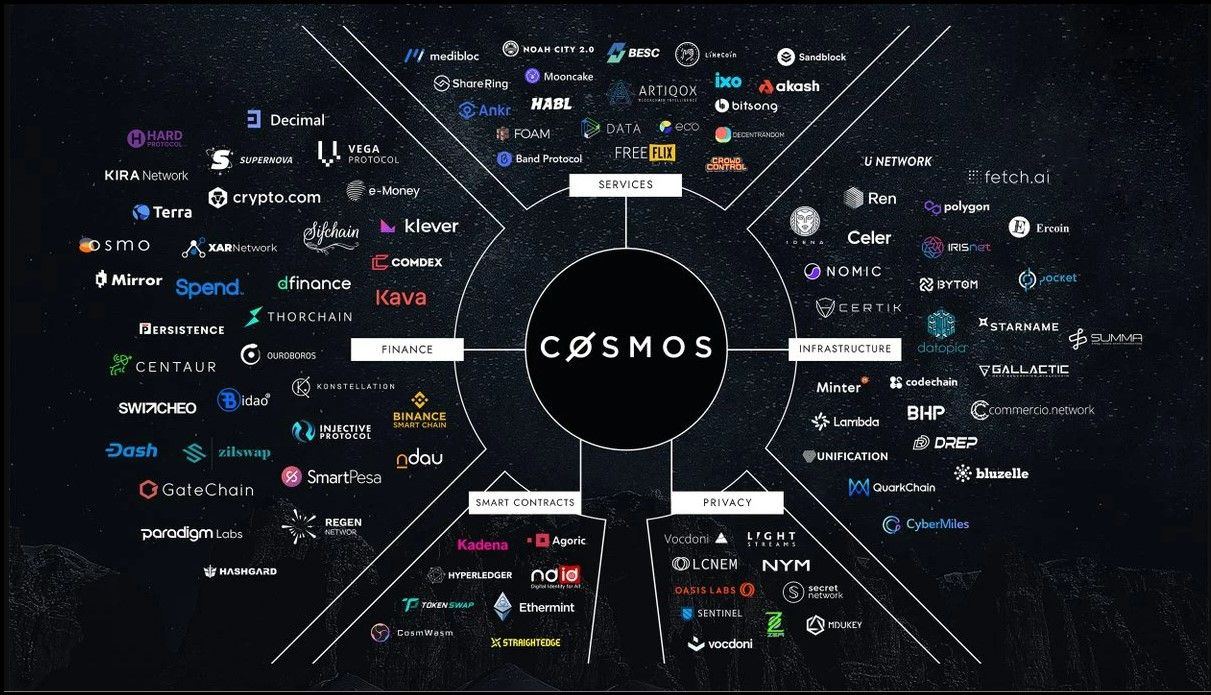
The trade-off is clear: users gain access to a richer, more diverse set of financial instruments, but they must navigate a more complex security landscape. Understanding how IBC orchestrates this flow of value is essential for evaluating the long-term viability of Cosmos-based DeFi protocols. As the ecosystem matures, the focus shifts from mere connectivity to optimizing the efficiency and security of these interchain connections.
Top Cosmos DeFi protocols compared
Choosing the right Cosmos DeFi protocol requires looking beyond headline TVL numbers. The ecosystem is fragmented across independent blockchains, each with its own security model and liquidity depth. For high-stakes strategies, understanding the specific utility and trade-offs of each project is essential to managing risk.
The following comparison highlights three leading protocols that represent different segments of the Cosmos ecosystem: a lending hub, a decentralized exchange, and a liquid staking derivative. Each serves a distinct function in the broader Cosmos Crypto DeFi analysis framework.
Osmosis dominates the decentralized exchange (DEX) space within Cosmos. It operates as a fork of Uniswap V2 but has evolved to support cross-chain swaps via IBC. Its primary advantage is deep liquidity for Cosmos-ecosystem tokens. However, the risk here is concentrated in impermanent loss for liquidity providers, especially in volatile pairs. For traders, Osmosis offers the best slippage protection for Cosmos-native assets.
Kava provides a lending and borrowing platform that integrates with Cosmos IBC. It allows users to mint stablecoins against crypto collateral. The trade-off is higher complexity; users must manage collateralization ratios across different chains. Kava’s reliance on external oracles for price feeds introduces oracle risk, which can lead to liquidations if price data is delayed or inaccurate.
Stride is the leading liquid staking solution for Cosmos. It allows users to stake ATOM and receive stATOM, which can be used in other DeFi protocols. This solves the liquidity lock-up problem inherent in proof-of-stake networks. The primary risk is smart contract vulnerability; if the staking module is compromised, user funds could be at risk. Additionally, unbonding periods (6 days for ATOM) mean that stATOM is not instantly redeemable for native ATOM during network stress.
When selecting a protocol, consider your exposure tolerance. Osmosis is best for active trading and liquidity provision. Kava suits users seeking yield through lending, provided they monitor collateralization closely. Stride is ideal for passive stakers who want to maintain liquidity. Always verify real-time TVL and risk metrics, as the Cosmos ecosystem evolves rapidly.
Staking Yields and Interchain Security Risks
Cosmos Crypto DeFi analysis reveals that staking ATOM offers a compelling yield, but it comes with distinct structural risks. The network’s design allows validators to secure multiple zones, creating a shared security model that is both its greatest strength and its most significant vulnerability. When you stake ATOM, you are not just betting on one chain’s performance; you are participating in a complex web of interdependent systems.
Understanding the Yield
The average APY for ATOM staking typically hovers between 12% and 18%, depending on the validator and current inflation rates. This is generally higher than many other major Layer 1 blockchains, making it attractive for passive income seekers. However, these yields are not fixed. They are driven by inflation, meaning the real value of your stake can fluctuate based on token supply dynamics and market sentiment. Always check live data from sources like Cosmoscan or Simply Staking for the most current rates.
The Slashing Risk
Slashing is the most immediate financial risk for stakers. If a validator you delegate to misbehaves—such as by going offline or double-signing—the protocol penalizes them by burning a portion of their stake. As a delegator, you share this penalty. While major validators often have insurance funds to cover these losses, smaller validators might not. This means your yield can be wiped out in a single incident if security protocols fail. It is essential to choose validators with a long track record and transparent operational history.
Interchain Security and Centralization
The Cosmos Hub’s move toward Interchain Security (ICS) allows other chains to lease its security. This improves safety for new zones but introduces centralization concerns. If a large percentage of ATOM stakers choose to secure only a few high-profile zones, the Hub itself could become vulnerable. Additionally, IBC relayer failures can cause cross-chain transactions to stall or fail, potentially locking assets or causing arbitrage opportunities to vanish. These technical risks are inherent to the multi-chain architecture and require constant monitoring.
Weighing the Trade-offs
For high-stakes investors, the decision to stake ATOM is not just about yield. It is about risk tolerance. The potential for high returns is real, but so is the risk of slashing and systemic interchain failures. Diversifying your staking across multiple validators and staying informed about network upgrades can mitigate some of these risks. However, no strategy eliminates the possibility of loss in this complex ecosystem.
Cosmos Crypto DeFi Outlook and FAQ
The Cosmos ecosystem continues to evolve from a collection of independent blockchains into a cohesive interchain economy. For investors analyzing Cosmos crypto DeFi opportunities, the core value proposition remains its ability to facilitate seamless communication between heterogeneous networks. This infrastructure layer reduces fragmentation, allowing yield opportunities to flow more efficiently across the network.
However, high-stakes investment in ATOM requires acknowledging significant trade-offs. While the technology is robust, the tokenomics have historically struggled to capture value from the increasing transaction volume on the network. Investors must weigh the potential for long-term infrastructure dominance against short-term price volatility and competition from other interoperability solutions.
Helpful gear
Use these product recommendations as a starting point, then choose the size, material, and price point that fit how you actually use the gear.


As an Amazon Associate, we may earn from qualifying purchases.
No comments yet. Be the first to share your thoughts!